Nigel has circulated members with preliminary details:
The OUS SWF season is almost upon us.
Our first event will take place on Thursday 16 May. It will consist of a private guided tour of the Musée Napoléon, housed in the Château de la Pommerie, property of a descendant of the Emperor.
The château lies just outside the village of Cendrieux (24092), some 20–25 mins north-east of Bergerac. Our visit will be preceded by lunch at Restaurant Chez Julien in Paunat (24510).
Further details of this first event will be circulated in early April.
The outline schedule of summer events is as follows. As soon as we have more detail, we shall post it on the website.
26 June: 46000 Cahors
Mid-July: 46100 Figeac
5 September : AGM, probably at Mélange, 24240 Saussignac
Late September/early October: 32000 Auch
We shall also see whether it might be possible to arrange at some stage during the summer a lunch in the Agen/Villeneuve-sur-Lot area complete with invited speaker.
Our final event of the year will be a visit on Friday 13 October to the town of Montauban (which is, incidentally, a regular stop on the main railway line from Bordeaux to Toulouse).
The local Tourist Office has arranged for us to have an English-language guided tour of the old part of town, starting out at 10:45 from the Office (2 rue du Collège, 82013 Montauban). The distances involved are small and we shall then lunch close by. The plan in the afternoon is to visit the Musée Ingres-Bourdelle.
Members have been sent booking details (deadline 5th October) by email.
We shall on 25 July be visiting the Collection nationale de nénuphars at Le Temple-sur-Lot, between Ste-Livrade-sur-Lot and Clairac.
The French impressionist painter Claude Monet (1840–1926) created a now much visited garden at Giverny in Normandy, where he lived for the last 43 years of his life. One feature of that garden was his collection of the water lilies that frequently feature in his work.
What is perhaps less well known is that most of those water lilies came from the nurseries established at Le Temple-sur-Lot by Joseph Bory Latour-Marliac (1830–1911). Born at nearby Granges-sur-Lot, Latour-Marlic was a practising lawyer but devoted much of his energy to creating water lily hybrids. The two men first met at the Paris Exposition Universelle of 1889.
If we can muster a group of 15 or more, we shall be able to take advantage of the Group Day Pass offered by the nursery. This includes a one-hour guided visit in English starting at 10:30, some free time to wander the gardens at will, and a three-course lunch of local produce in the on-site restaurant set amid bamboos. More information can be found on the nursery website: <https://www.latour-marliac.com/fr/>.
There are a number of other places of interest in the area should any of us wish to continue into the afternoon. Among these is the Musée du Pruneau, just 7 km. away, at Lafitte-sur-Lot.
We have undertaken to give the nursery advance notice of numbers. If you wish to join us, please reply to this email (also indicating whether you will be bringing guests) not later than Sunday 16 July. More details will be sent to takers early the following week.
Nigel has written to members (who should see his email for booking details):
In July, we shall be visiting the Collection nationale de nénuphars, established by Claude Monet’s botanist friend Joseph Bory Latour-Marliac at Le Temple-sur-Lot, near Ste-Livrade (for more see <https://www.latour-marliac.com/fr/>).
But our next outing will be on Wednesday 21 June, with lunch in Villandraut and a tour of the Château royale de Cazeneuve, near Préchac .
The following account of the château comes courtesy of Marion.
The river Ciron winds nonchalantly for nearly all of its 96 km, from the Landes wetlands to the Garonne near Langon. Flowing mainly under a thick canopy of woodland, its waters remain cool and in autumn are shrouded in the mist which encourages the formation of the fungus known as ‘pourriture noble’, essential for the production of Sauternes wine. But part of its course is steeped in history.
Near Préchac, on a site which was once that of neolithic hunters, the Dukes of Albret built a fortified manor house, a convenient stop-over for Edward I of England, Louis XIII and Louis XIV. After the death of Jeanne d’Albret in 1572, it was inherited by her son Henry of Navarre, much loved King of France, and his then wife Marguerite de Valois, better known as the ‘Reine Margot’, whose deeds and alleged misbehaviour are described in Alexander Dumas’ eponymous novel. Used as a favourite hunting lodge, they extended and remodelled it in the Renaissance style.
Margot not being able to produce an heir, Henry imprisoned her here while negotiating a divorce. Legend makes her (probably unfairly) something of a nymphomaniac, and she is said to have conducted her amours in a riverside grotto reached by an underground passage.
The château has been lived in ever since by descendants of the Albret family, the Dukes of Sabran-Pontevès, who have renovated and furnished it to a high standard, in styles ranging from the 16th to 18th century. It retains the atmosphere of a loved country seat rather than that of a fortified castle. In the 19th century, the surrounding parkland of 40 hectares was laid out in what the French call the ‘English style’, with grassland, specimen trees, a remarkable bamboo plantation, and walks down to the river and Margot’s grotto. The area is now a wildlife reserve.
Nigel has written to members with details of our next visit, in summary below.
“As advertised, our next outing will be Wednesday 17 May to the Château de Fénelon, 24370 Sainte-Mondane. On this fortress, prominent during the 100 Years’ War and the Wars of Religion and birthplace of the writer, bishop, and royal chaplain (1651–1715), there is an unusually informative website (in both French and English): <https://chateau-fenelon.fr/>….
The château has been closed all spring for the filming of Christopher Thompson’s adaptation of Robert Merle’s 13-vol. Fortune de France….
Our third 2023 event will be an afternoon visit on Wednesday 21 June to the Château Royale de Cazeneuve, 33730 Préchac, with lunch at l’Escale du Ciron in Villandraut.
When the Committee last met, it asked that all members be reminded that the terms of office of the entire committee and all the officers of the Association will expire at the AGM we shall hold in Moissac on Wednesday 13 September. As indicated in a previous message about the Castelsarrasin/Belleperche event last month, we would be very grateful if members would consider helping us by being willing to stand for election then.
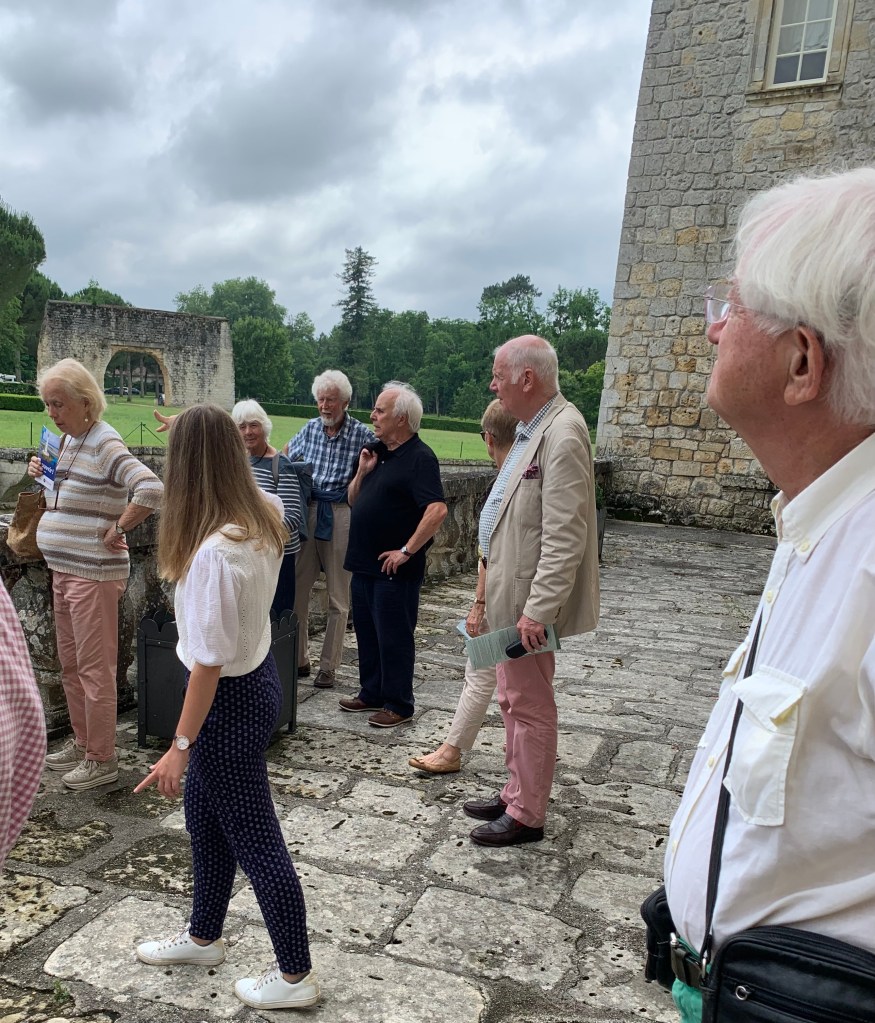
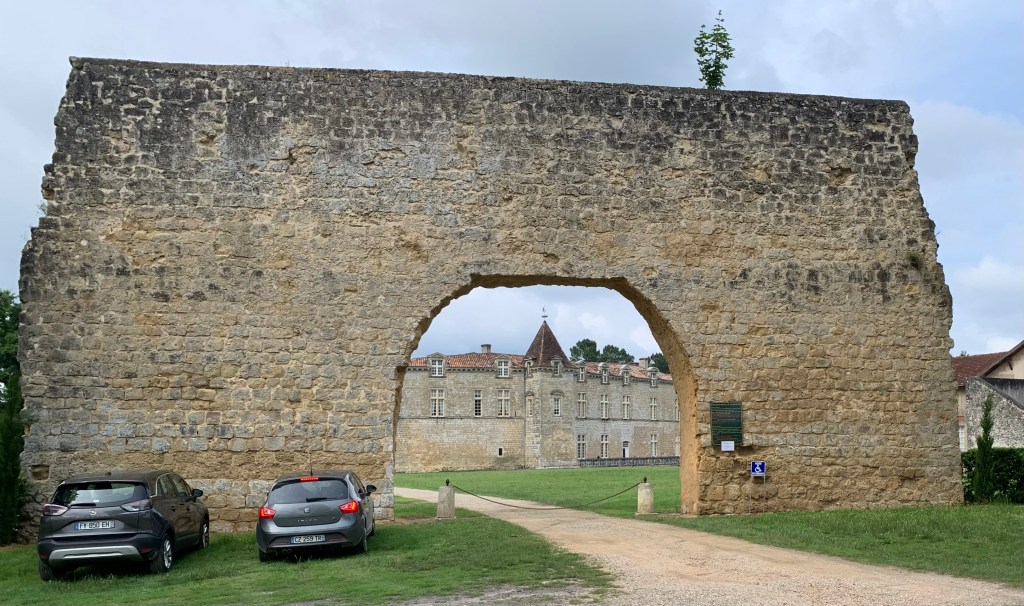
Our first visit of the season allowed a group of eighteen alumni, family and friends to enjoy two museums and partake in an agreeable lunch in between. Both museum visits had excellent guides who brought to life for us fin-de-siècle French culture and the art of the table from mediaeval times onwards.
The Espace Fermin Bouisset museum evokes the magical period when new forms of art – including Bouisset’s advertising art – flourished. We saw how effectively he advertised each brand through the eyes and therefore the back of a child, often with just the brand name as the message – a technique which lasted successfully for many decades. Our guide expertly highlighted the cultural and social changes of the late nineteenth and early twentieth centuries.
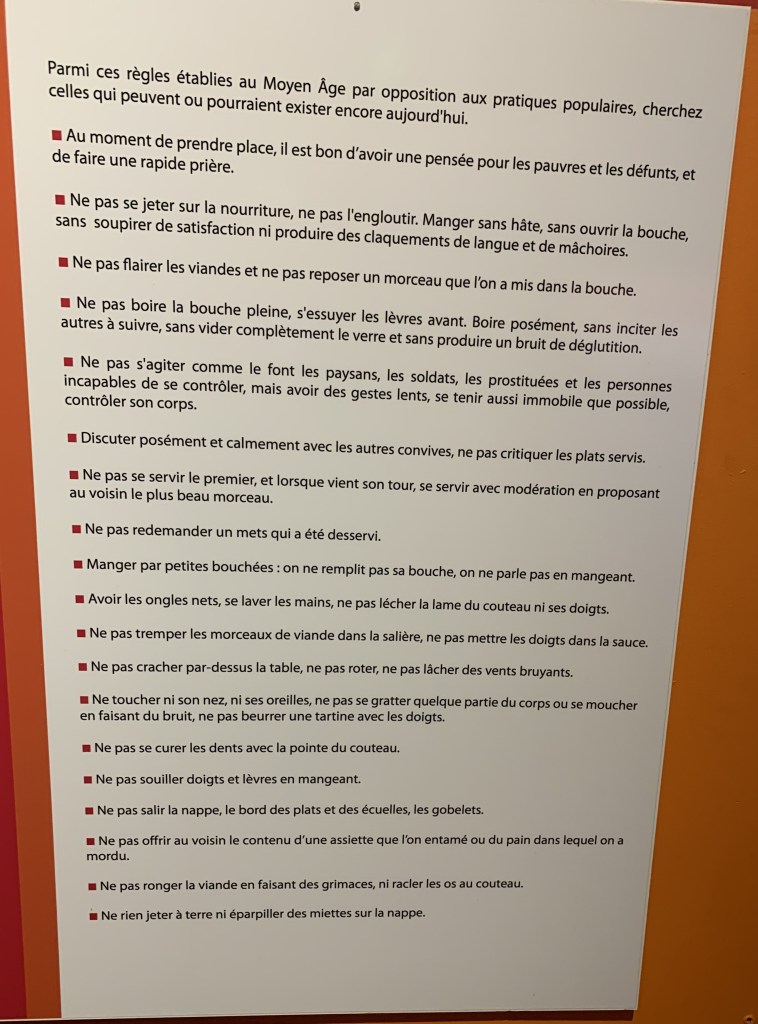
Our guide at the Abbey of Belleperche dramatised the culinary pleasures and habits of the mediaeval aristocracy, with many insights into the evolution of table protocol, manners (see below) and tableware. The seigneur consumed food which came from as close to God as possible – the unfortunate high-flyers of their day. Forks were banned for their devilish connection, but soon practicality won the day.
Our thanks are due to both Marion and Nigel for organising the visit, and to Nigel for coping with late arrivals caused by the dreadful weather, market and road-works at the Bouisset Museum door.
Our secretary Nigel has emailed members with details of our spring events. Members should contact him nigelhgriffin@gmail.com if they have not received an email and wish to attend.
The first event will be on Thursday 13 April with a guided tour of the Espace Firmin Bouisset in the Maison d’Espagne in Castelsarrasin (81) and its collection of iconic posters and designs. Lunch will be at the Auberge du Moulin on the outskirts of Castelsarrasin followed by a guided visit of the rich collections of the Musée des arts de la table housed in the nearby Cistercian Abbaye de Belleperche on the banks of the Garonne.
Our second event will be a visit on Wednesday 17 May to the Château de Fénelon (Ste-Mondane, 20km SE of Sarlat), a prominent fortress during the 100 Years’ War and the Wars of Religion and the birthplace of the writer, bishop, and royal chaplain, who lived 1651–1715.
This is a message for members to draw your attention to the email will just have received from our secretary, Nigel. If you have not received the email, please contact us on info@ousswfrance.com.
This posting covers most of the points but there is more detail in the email.
Why are we asking for members’ involvement and help?
Possible places in which to hold 2023 events were discussed at the most recent committee meeting. These included museums, towns of especial interest, and—as ever—châteaux and vineyards. It was felt that we could ask for input from members about these and also about: possible venues for the autumn 2023 AGM; the idea of holding a meeting with an invited speaker; and how we might identify new members. The committee meets again in January 2023 so we would be grateful for your input before that.
May we, then, please ask for members’ thoughts on:
1 AGM.
Do you think we should continue our policy of holding the AGM in different parts of our (enormous) catchment area?
Or would you prefer us to identify a single, central site which we know works well and then meet there every year?
We have had invited well-known speakers on at least four occasions. Do you favour our doing so again? Maybe not, but, if so, canwe try to invite someone who lives locally?
Do you know (of) anyone whom we might ask to speak to us?
2 Events.
Since Covid, most of our excursions have been to châteaux and vineyards. Do you think we should vary this pattern by staging some, at least, of our four or five gatherings this coming year in towns with museums, galleries, concert halls, or other sites of cultural interest?
If so, might you prefer us to select venues which have access by bus and/or train or are close to a motorway?
3 Membership.
We are always on the look-out for new members
Do you know of any Oxford alumni living locally, full-time or even part of the year, whom you feel might be persuaded to join us?
Can you suggest ways we might draw attention to our existence and to what we do?
We would appreciate it if members can bring their membership up to date by paying the annual subscription of €10 at their earliest convenience.
4 Committee.
The remit of the present office holders and the entire committee expires at the 2023 AGM. We would very much appreciate it if any member, and especially someone from the younger cohort, would like to put himself/herself up for the committee and participate more fully in helping to organize our programme.
Please reply directly to Nigel or via info@ousswfrance.com.
Our 2022 AGM was held at the end of September at Gaillac (Tarn), in the pleasant surroundings of the Hôtel Restaurant La Verrerie and was followed by an enjoyable lunch. Committee member Christopher Boddington, who made the arrangements for us, took us that morning to the splendid 12th-century Château de Mayragues (enlarged in the 17th), a monument historique close by the bastide of Castelnau-de-Montmiral and complete with chemin de ronde en encorbellement. Once a ruin and now lovingly restored, it was in 1998 awarded the Grand prix des vieilles maisons françaises. There we were treated by Alan Geddes to a relaxed and informative tasting of the family’s biodynamic wines and several members who bought a case or two on the day have since reported favourably on their quality
The Association being in decent financial shape and with all office-holders in post until the 2023 AGM, the business side of the meeting was dispatched briskly. It was agreed to maintain the annual subscription at €10 and details of how this might be paid were included in the Minutes emailed to members. Outline arrangements for our 2023 programme will be discussed in November/December and members will then be canvassed for opinions/suggestions via the website and an email circular.


 OUS South West France
You must be logged in to post a comment.